Katt Williams Has One Question: Why Are You Already Mad at Breakfast?
IT’S 7 A.M. WHAT DID THE BACON DO TO YOU?
There is waking up on the wrong side of the bed, and then there is bringing an entire day’s worth of hostility to breakfast.
Katt Williams finds a joke in the second kind of morning: the person whose determination to look tough has somehow followed him all the way to his plate.
In “15 More Minutes of Katt Williams,” uploaded by Netflix Is A Joke, that breakfast premise sits alongside a reminder to enjoy life and a comic scenario about an unpaid electric bill.
Together, those moments offer a useful way to listen to stand-up: notice what changes when the practical problem stays exactly the same.
Our reading is that these jokes get their energy from a mismatch between the situation and the character’s response.
You do not need to agree with every opinion in the compilation to recognize that construction—or enjoy discovering how it works.
Viewing note: The compilation contains strong language and adult material, including drug references, religion, and politics.
Why breakfast is the perfect place for this joke
The breakfast passage describes someone acting aggressively at seven in the morning, then brings that aggression down to the level of bacon.
The published transcript of the compilation records this progression.
The setting matters.
Breakfast is ordinary, domestic, and usually a beginning rather than a climax.
Put an oversized attitude in that small setting and the attitude becomes easier to see.
Imagine the difference between describing someone as “always angry” and showing them treating a toaster as a personal adversary.
That toaster example is ours, not a line from Williams.
The first description gives us a label; the second gives us a scene.
This is a useful distinction when watching observational comedy, the kind that builds on recognizable everyday behavior.
Recognition gets you into the joke.
The unusually specific detail gives you a reason to laugh rather than simply nod.
On a rewatch, ask yourself when you stop hearing about a personality and start picturing a particular morning.
That is where the broad observation becomes something you can almost see across your own kitchen table.
The electric bill stays unpaid—but the story changes
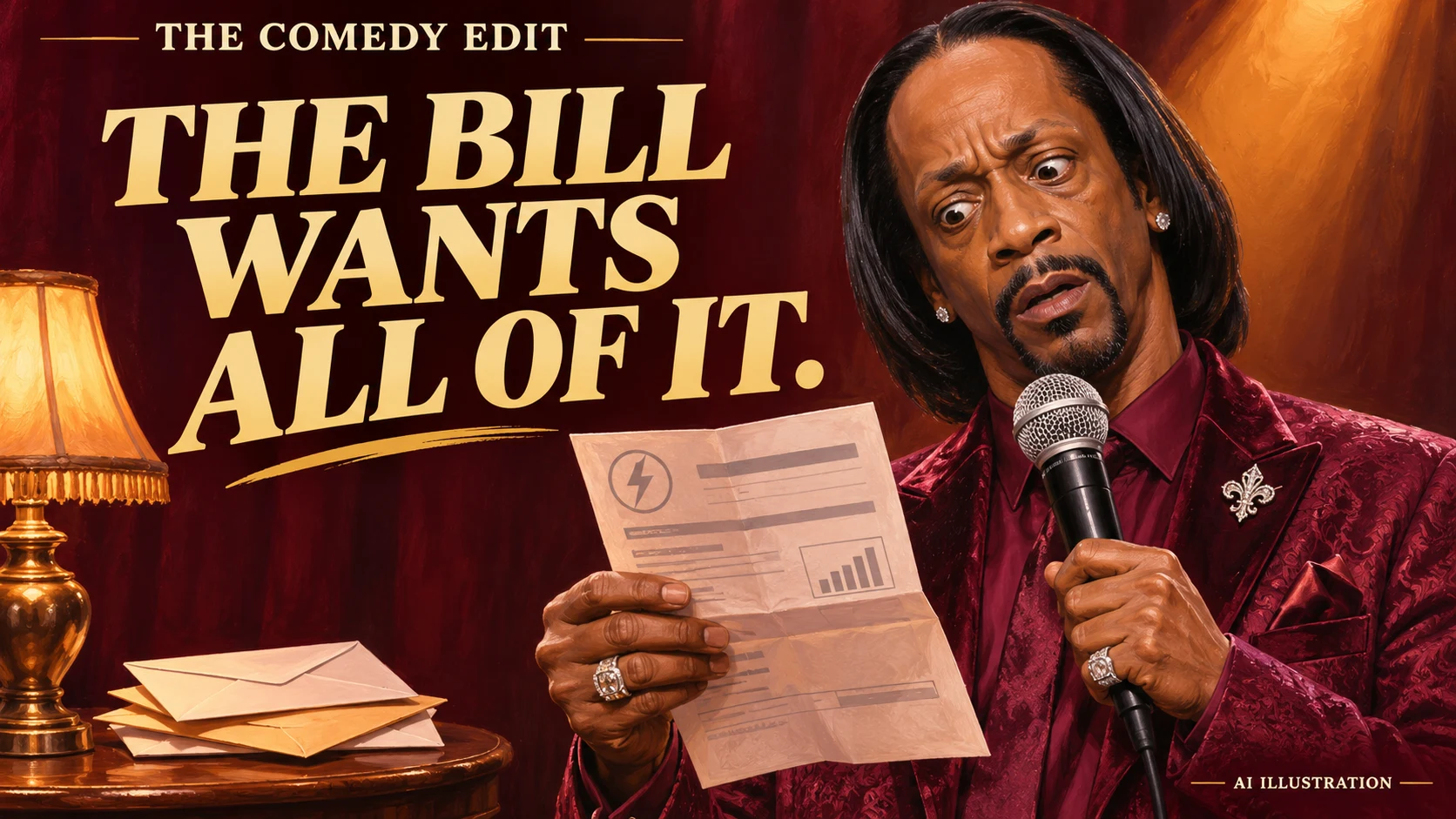
The bill passage begins with a demand for payment and a worried response.
Later, the character’s attention shifts to the candles already available at home.
The routine uses marijuana as the comic explanation for that change in outlook.
The construction is more interesting than a simple change from unhappy to happy.
There is no newly discovered paycheck in the scene.
Instead, the character changes what counts as good news.

That distinction separates a practical solution from a comic reframing.
A practical solution changes the circumstances.
A comic reframing can leave the circumstances alone and change the meaning attached to them.
Think of a canceled picnic becoming an enthusiastic celebration of not having to wash the picnic blanket.
That is an original comparison from The Comedy Edit, not another Williams joke.
The disappointment remains, but a wonderfully small consolation receives an absurd promotion.
The pleasure comes from understanding both versions at once.
You can recognize why the problem matters while also recognizing how determined the character is to find a more comfortable interpretation.
Watch the official compilation: 15 More Minutes of Katt Williams — Netflix Is A Joke.
This link opens the YouTube compilation, not a complete stand-up special.

Why the ordinary object does so much work
Bacon and candles are easy to picture.
They do not require a long explanation, a celebrity backstory, or familiarity with a particular news event.
That leaves more room for the strange attitude attached to them.
Here is a small editing experiment you can try while watching any everyday-life routine.
Replace the specific object in your mind with a general phrase such as “my breakfast” or “something useful.”
Does the scene become less vivid?
If it does, the object is contributing more than decoration.
It is helping the listener build the situation quickly.
The comedian can then spend the next line changing that situation’s emotional meaning instead of explaining where everyone is.
This is also why retelling a joke as a general life lesson often loses the funny part.
“Try to relax” may express an idea, but it does not create a character, a setting, or an unexpected response.
The scene gives the idea somewhere to happen.
Try this three-question rewatch
You can use this quick method without turning your evening into homework.
Pick one short passage and listen for three things.
1. What is the ordinary situation?
Describe it in one plain sentence, with no punchline.
If you can identify the everyday situation, you have found the point where the routine invites recognition.
2. What response would make sense?
Name the expected emotional response before considering the exaggerated one.
That gives you a baseline.
A comic reaction feels oversized only when there is something ordinary to compare it with.
3. What changes: the problem or the interpretation?
This is the most useful question for the bill passage.
It helps distinguish an event in the story from a change in the character’s priorities.
A scene can move forward even when the external circumstances barely move at all.
There is no requirement to laugh at the same point as someone else.
One viewer may enjoy recognition; another may prefer exaggeration.
Being able to name that preference makes the conversation more interesting than simply deciding whether a clip is funny.
Take the joke seriously enough to notice its construction
This article treats the routine as comedy, not as financial or health guidance.
Its value here is the opportunity to notice a storytelling choice: an everyday problem becomes a scene when someone reacts to it in a revealing way.
Next time you watch, keep one question in mind:
Is the situation ridiculous—or is the response making it ridiculous?
That question travels well beyond this compilation.
It works with workplace stories, family arguments, and almost any routine about a perfectly ordinary day going emotionally off the rails.
Watch: 15 More Minutes of Katt Williams
Open the compilation on YouTube.
YOUR TAKE
What makes an everyday-life joke work for you?
Pick the answer closest to your point of view.
Thanks for sharing your take. There is more than one way to enjoy a good story.
Your choice stays on this browser. No public vote count is collected.